On this page
From equations to executable code
The simulator is plain JavaScript. The numerical core has no renderer dependency and exposes globalThis.Stewart in a browser or Node. The English interface and lesson presets reuse this core; they do not contain a second physics implementation.
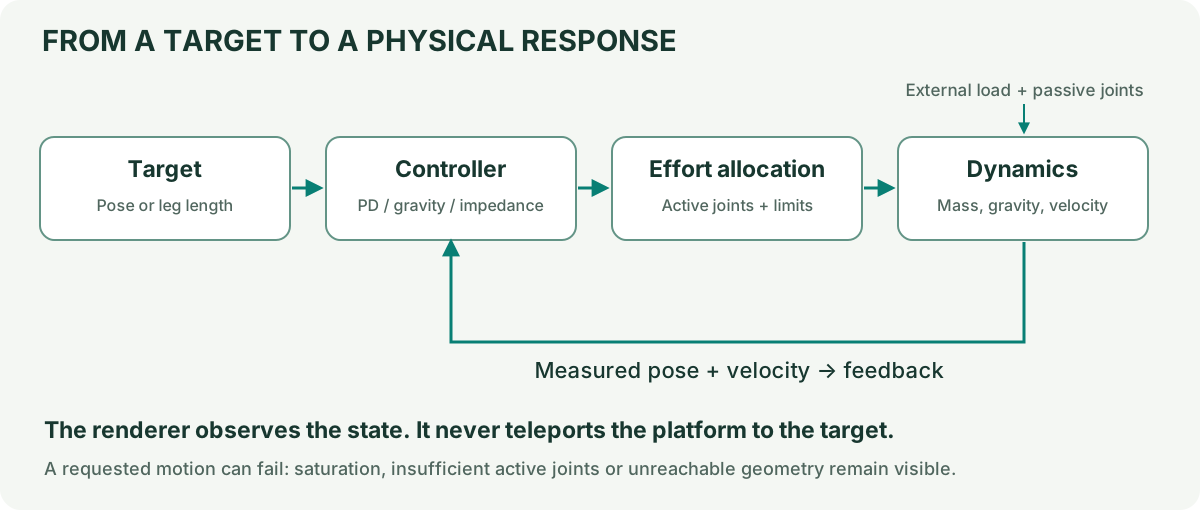
| Concept | Implementation in core.js | Inspect / test |
|---|---|---|
| Attachment positions and leg lengths | createGeometry, kinematics |
IK → FK round trips |
| Linear / angular body Jacobians | pointJac, kinematics |
Central differences of all 12 columns |
| Local FK | forwardKinematics |
Residual, initial seed, rejected input |
| Mass and gravity | massAndGravity |
Symmetry, positive definiteness, potential gradient |
| Velocity coupling | dynamics |
Contact-free energy identity |
| Passive springs / dampers | jointRows, passiveTau, orientationError |
Passive energy gradients and decay |
| Available motor axes | activeColumns |
18 joint groups, up to 42 effort components |
| Bounded effort allocation | allocate |
Saturation and residual, not assumed perfect allocation |
| IK, gravity, compliance demand | jointRows, internal controlDemand |
Tracking, holding and F/K experiments |
| Time integration | step, shift |
Fixed dt, finite states and bounded efforts |
| Inverse dynamics | inverseDynamics |
External-wrench subtraction; excludes contact stops |
| Save / restore | snapshot, restore |
Round trip and invalid-input rejection |
A minimal headless experiment
require('../src/core.js');
const S = globalThis.Stewart;
const sim = S.makeSimulation();
sim.settings.mode = 'compliance';
sim.settings.translationK = 800;
sim.settings.external = [16, 0, 0, 0, 0, 0];
for (let i = 0; i < 1500; i++) {
  S.step(sim);
  if (sim.halted) throw new Error(sim.error);
}
console.log('X displacement [mm]:', 1000 * sim.state.p[0]);
Run the supplied example from the repository with node examples/compliance.cjs. Browser users can load the supplied JSON examples through Load project, then press Run. Imports intentionally open paused.
Coordinate conventions worth checking
All world wrenches act at the platform reference origin. Quaternion order is [w,x,y,z]. The orientation update left-multiplies a world-frame rotation increment. UI roll/pitch/yaw uses Rz(yaw) Ry(pitch) Rx(roll); Euler angles are not integrated as generalized velocities.
The six-row leg Jacobian maps platform twist to leg speeds. Therefore W = J^T f maps axial leg forces to platform wrench. Some serial-robot texts define the Jacobian in the opposite direction. Read the definition before copying a transpose formula.
The internal state contains p, q, six spin coordinates, twelve generalized speeds v, and simulation time t. The six spin coordinates capture rotations of the telescoping leg assemblies; their values cannot be inferred from six lengths alone.
Code ownership
src/core.js owns physics and model validation. src/app.js owns controls, readouts and recording. src/renderer.js owns the WebGL / CPU rendering paths. src/lessons.js only selects existing modes and goals. src/shell.html and src/style.css own the interface. build.py assembles the single-file app and projects canonical Markdown into static learning pages.
The original Korean HTML in archive/ko/ is a frozen release, not a second maintained implementation. Its SHA-256 is checked. New behavior is implemented in the English source; backporting is a separate decision.
Ball, finite drive and user-mode ownership
src/ball.js owns sphere contact, position observation and the outer loop; it writes a pose target only when ball feedback is enabled and the inner mode is IK. src/actuator.js owns the optional averaged drive, encoder/gyro/FK state and version-2 persistence. src/ball-ui.js owns explicit manual takeover, resume and reset actions; src/app.js owns the workbench, import invalidation and current-mode availability of controls. src/mechanical-view.js renders the shared deck/socket geometry.
tests/usability.test.py exercises the real return path, reset after fall, manual target ownership, no ghost rotor inertia after leaving the servo, disabled controls, invalid input, FK invalidation, help shortcuts, mobile layout and overlay controls. Its default is HTTP; --url verifies a deployed site. The explicitly labelled --injected fallback is not hosted acceptance.
Research extensions, not current capabilities
Cross-engine validation, independent plant/controller parameters, anisotropic spherical stiffness, full mesh collision, calibrated bearing limits, phase-resolved electronics and collision-aware workspace analysis are possible follow-on studies. They are not enabled by a successful screenshot or a passing same-model regression. Keep such claims separate from the current evidence.